What is literature search: A practical guide for researchers
Staring down a new research project can feel like standing at the edge of a vast, uncharted forest. You know the answers are in there somewhere, but where do you even begin? That overwhelming feeling of "what now?" is precisely where a literature search comes in. It’s the systematic process of finding, evaluating, and truly understanding what’s already been said about your topic. Think of it less like gathering sources and more like academic detective work—piecing together clues to map out the existing territory before you start your own investigation.
A great search is far more than a simple paper-collecting exercise. It’s about laying a solid foundation for your own work. A truly effective search helps you:
- Pinpoint foundational studies and the core arguments that have shaped the entire discussion in your field.
- Identify critical knowledge gaps—those little unexplored corners where your research can make a real impact.
- Grasp the major debates and see how different researchers' findings connect, conflict, or build upon one another.
This whole process has gotten trickier over the years. The sheer volume of published research is doubling roughly every nine years, creating a tidal wave of information. This data explosion has sparked a huge demand for tools to manage it all, with the market for literature review software projected to surpass $850 million by 2029. You can read the full research on the literature tools market to see just how big this space has become.
Instead of getting lost in a sea of PDFs and endless browser tabs, you need a system. This is why we built EagleCite, a platform designed to help you gather, organize, and make sense of your findings from day one. Let's break this process down into clear, manageable steps so you can turn this daunting task into one of the most insightful parts of your research workflow.
A successful literature search transforms you from a passive reader into an active participant in the scholarly conversation. It's what sharpens your research question and gives your entire project direction.
Core Components of an Effective Literature Search
To really get a handle on this, it helps to break the search down into its fundamental parts. Each component has a clear goal and a specific action you need to take.
| Component | Objective | Key Action |
|---|---|---|
| Scoping & Planning | Define the boundaries and scope of your search. | Develop a focused research question and list relevant keywords. |
| Systematic Searching | Find all relevant literature across multiple databases. | Execute keyword-based searches in databases like PubMed, Scopus, or Google Scholar. |
| Screening & Selection | Filter out irrelevant studies based on predefined criteria. | Review titles, abstracts, and full texts to select papers that fit your scope. |
| Data Extraction | Pull out key information from the selected articles. | Systematically record findings, methodologies, and conclusions. |
| Synthesis & Analysis | Identify patterns, themes, and gaps across all studies. | Group findings, compare results, and construct a narrative of the existing research. |
This structured approach turns what could be a chaotic mess into a clear map of your field. Having a central hub where your literature becomes an organized, searchable knowledge base is critical. In EagleCite, you can use project-based workspaces to manage each of these stages, allowing you to focus on the exciting part—the analysis—not the tedious admin work.
Your 5-Step Literature Search Framework
A great literature search isn't a frantic scramble for papers; it's a systematic process. Having a clear, actionable framework turns what feels like an overwhelming task into a series of manageable steps. Think of it as building a map of the existing knowledge so you know exactly where your own research fits.
This journey starts by defining your destination (your research question) and ends with a deep understanding of the scholarly conversation you're about to join. The visual guide below breaks down the core stages: scoping your search, evaluating what you find, and pulling it all together.
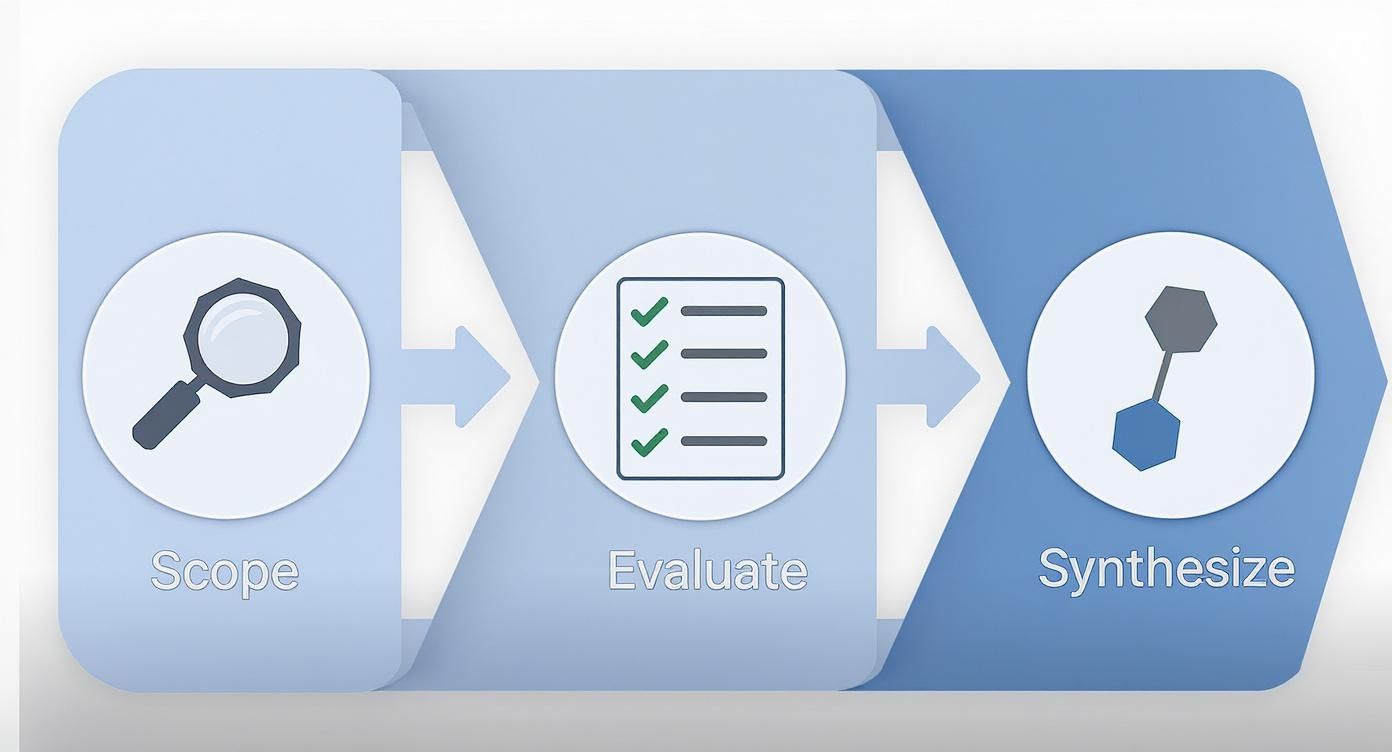
As you can see, each stage builds on the one before it, helping you move from a broad topic to a focused, well-curated collection of relevant literature.
Let’s walk through the complete 5-step process you can implement immediately.
Step 1: Define Your Research Question
Your research question is your north star. Without a good one, you're just wandering. A vague question like "What about climate change?" will flood you with millions of results, most of them useless.
A strong, specific question like, "What is the impact of coastal erosion on salt marsh ecosystems in North America?" gives you clear boundaries and a perfect set of initial keywords to work with.
Step 2: Choose the Right Search Tools
With your question in hand, you need to decide where to look. Sure, Google Scholar is a decent starting point, but for a serious deep dive, you need specialized databases. Think PubMed for biomedical research, Scopus for a broad scientific overview, or JSTOR for humanities and social sciences.
Using a mix of tools helps you avoid disciplinary blind spots and ensures you're seeing the full picture.
Step 3: Execute Your Search Strategy
This is the active "hunting" phase. You'll use your keywords combined with Boolean operators (the simple but powerful AND, OR, and NOT) to narrow or broaden your results. It’s the difference between finding a needle in a haystack and having the haystack deliver the needle to you.
For a masterclass on this, check out our detailed guide on effective literature search strategies and really level up your skills.
Step 4: Evaluate and Select Sources
Just because you found it doesn't mean it's useful. Now comes the critical filtering stage. Scan titles and abstracts to quickly gauge relevance.
Ask yourself a few key questions:
Does this paper directly* address my research question?- Is the methodology solid?
- Is this a foundational study that everyone else seems to be citing?
This quick triage saves you from wasting hours reading irrelevant articles.
Step 5: Organize and Synthesize Your Findings
This is where the real magic happens—where raw information transforms into genuine insight. As you collect papers, you have to organize them to spot themes, track arguments, and see how different studies connect. A messy downloads folder just won't cut it.
This is precisely why we built EagleCite's project-based workspaces. Instead of juggling files, you can create a dedicated hub for each research project. It keeps your PDFs, notes, and citations perfectly aligned, so you can focus on the thinking, not the administration.
Choosing Your Research Databases and Tools
The quality of your literature search really comes down to the quality of the tools and databases you're using. Kicking things off with a broad search on Google Scholar is a decent start, but for the kind of deep, credible research that gets published, you need to dive into specialized databases.
Think of places like PubMed for medicine, Scopus for scientific research, or JSTOR for humanities. These aren't just search engines; they're curated libraries filled with high-quality, peer-reviewed literature that a general search will likely never surface.
Of course, the real challenge isn’t just finding the papers—it’s keeping them all straight. We’ve all been there, lost in a sea of browser tabs with a downloads folder that looks like a digital warzone. This is precisely why a good reference manager isn't a luxury; it's an absolute necessity.
Instead of drowning in files, imagine using EagleCite's browser extension to grab articles and all their metadata from any database with a single click. It instantly pulls everything into your library, creating one organized, go-to spot for all your research materials. If you're curious about what makes a platform a better alternative to manual methods, take a look at our guide on essential features in literature management software.
Selecting the Right Mix of Tools
The smartest approach is to use a combination of broad search engines and specialized databases. The global search engine market is already huge, valued at around $252.5 billion, and it's only getting bigger as AI and accessibility improve. These advances are making general searches more powerful than ever.
But for a search that's truly exhaustive, you have to pair those general tools with databases specific to your field. And don't forget to look beyond traditional tools. Modern AI virtual assistants can also be a huge help in managing your daily tasks and keeping your workflow organized.
Here’s a look at how EagleCite’s browser extension works right on a PubMed search page.
That simple overlay lets you capture the source, the PDF, and all its metadata without ever leaving the search results. It completely eliminates the soul-crushing task of downloading and uploading every single file by hand.
The goal is to build a toolkit that lets you find information efficiently and organize it instantly. A great reference manager doesn't just store PDFs; it becomes your external research brain.
With a system like EagleCite in your corner, you get to spend less time on tedious admin work and more time on what actually matters: thinking, analyzing, and discovering something new.
From Information Chaos to Organized Clarity
So you've wrapped up a solid literature search, and your downloads folder is bursting at the seams with promising articles. Great! Now what? This is often where real research momentum hits a wall, leaving you buried under a mountain of PDFs and random notes. The truth is, finding the information is only half the battle; the real work lies in turning that raw data into a clean, usable knowledge base.
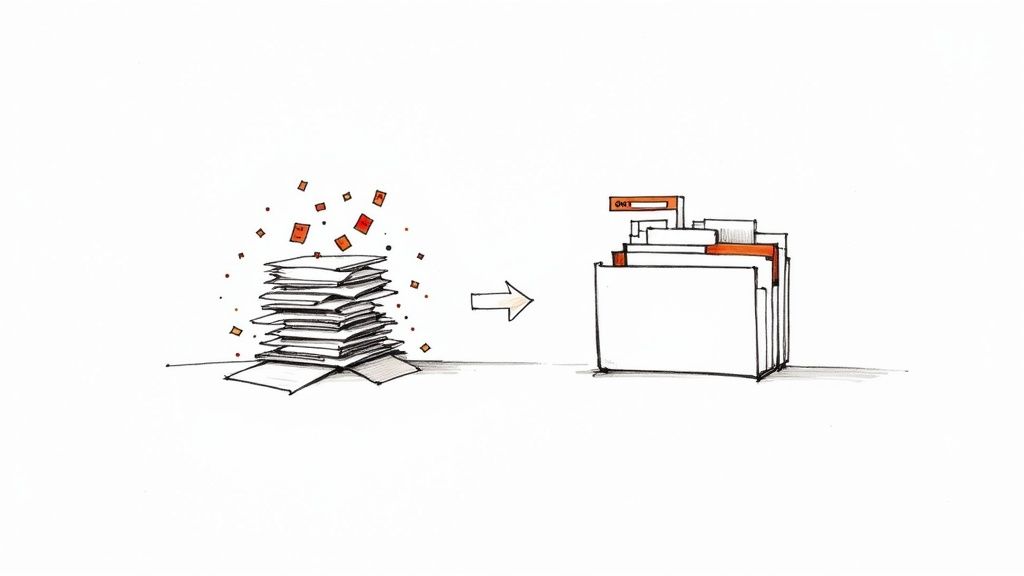
For decades, researchers have relied on manual methods like annotated bibliographies and thematic analysis to sort through their findings. While other tools like Zotero or Mendeley offer basic organization, they often lack the intelligent features to help you synthesize information effectively. This is precisely why we created EagleCite—to help you turn a chaotic folder into a searchable, intelligent research hub, going beyond simple storage.
Building Your Knowledge Base
The first step is to stop thinking of your downloads folder as just a place to dump files. To truly get a handle on the information you've gathered, you need a system. Learning how to organize research notes is essential for keeping your project on track. This means creating a structure that lets you easily categorize sources, tag ideas, and see the connections between different papers.
In EagleCite, you can build this structure right away:
- Nested Folders: Group your papers by project, theme, or even experimental method. Create a clear hierarchy that works for your specific workflow.
- Custom Tags: Add your own keywords to articles to track concepts, theories, or key authors across your entire library.
- AI-Powered Smart Tags: This is where you gain a unique advantage. EagleCite reads your documents and automatically suggests relevant tags, helping you spot themes and connections you might have missed on your own.
The goal isn't just to store papers; it's to build a personal, interconnected library of knowledge that makes your analysis and writing faster and more effective. A well-organized library is the foundation of a strong literature review.
By pairing smart organizational habits with the right tools, you can finally move from feeling overwhelmed by information to achieving genuine clarity. Start organizing your references in minutes with EagleCite.
Common Literature Search Mistakes to Avoid
Even the most seasoned researchers can stumble into a few common traps during their literature search. Learning to spot and sidestep these pitfalls right from the get-go is the key to saving yourself hours of frustration and building your research on a rock-solid foundation.
One of the biggest tripwires? Poor citation management. It’s a small oversight that can quickly snowball into a last-minute crisis.
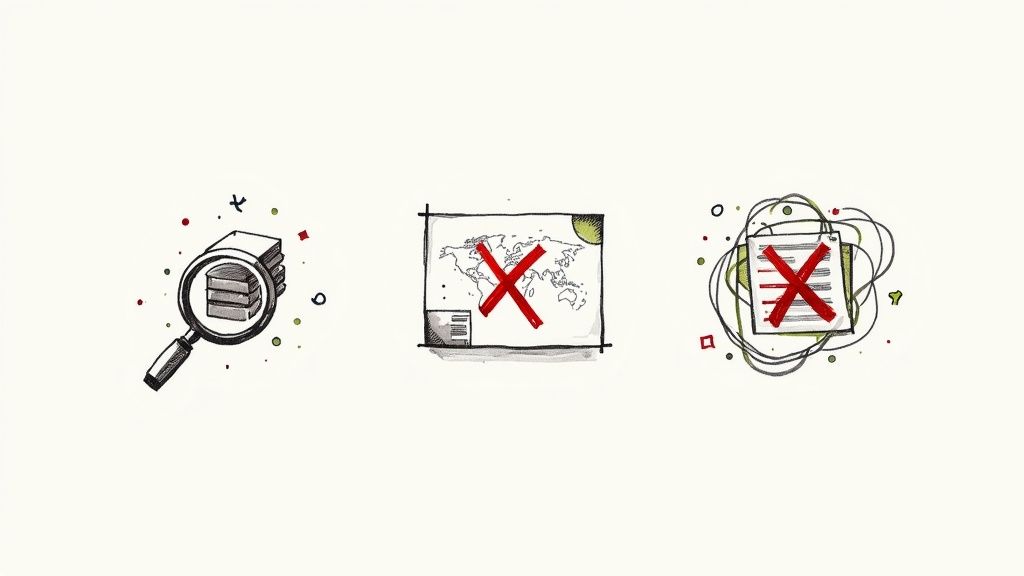
When you don’t keep track of your sources as you find them, you're not just creating a headache for later. You risk accidental plagiarism and end up on a frantic scavenger hunt for references right before your deadline. This is precisely why integrating a tool like Eagle Cite from day one is such a game-changer. Its automatic citation generation works directly within Word and Google Docs, so every source is formatted and tracked correctly while you write.
A disorganized search process doesn't just waste time; it compromises the quality and integrity of your work. The goal is a systematic workflow, not a chaotic scramble for information.
From Common Pitfalls to Best Practices
Knowing what not to do is the first step toward building a better, more effective search habit. Let’s look at how you can flip those common mistakes into best practices that actually work.
Common Pitfalls vs Best Practices
| Common Mistake | Why It's a Problem | Best Practice Solution |
|---|---|---|
| Using Vague Keywords | This floods you with thousands of irrelevant results while causing you to miss the most important papers. | Combine broad and specific keywords using Boolean operators (AND, OR, NOT) to sharpen your focus. |
| Relying on a Single Database | You introduce bias into your search and completely miss crucial research published elsewhere. | Search across multiple relevant databases like Scopus, Web of Science, and Google Scholar. |
| Ignoring Citation Trails | You miss out on both the foundational papers in your field and the newest studies that build upon them. | Actively use the "cited by" and "references" features in databases to explore the conversation forward and backward. |
| Disorganized Note-Taking | It becomes nearly impossible to connect ideas, synthesize your findings, or properly credit your sources. | Use a reference manager like EagleCite to attach notes and highlights directly to your sources, keeping everything in one place. |
By making a conscious effort to avoid these mistakes, you move beyond just passively collecting articles. You start strategically building a deep and comprehensive base of knowledge. A little proactive organization makes all the difference between a research process that feels like a struggle and one that feels genuinely productive.
Putting It All Together
Think of your literature search not as a one-and-done chore, but as an ongoing conversation with the thinkers and researchers in your field. It’s the very foundation of any project that hopes to be taken seriously. By moving away from a messy, manual approach and adopting a more systematic workflow—especially one aided by the right tools—you'll do more than just save time. You'll reduce a ton of stress and ultimately produce much better work.
Now you have a solid map for what a literature search entails and how to navigate around the most common traps. This kind of structured process is catching on everywhere. In fact, the market for Literature Review Software is growing at a CAGR of 8.2%, a clear sign that researchers are actively looking for smarter ways to handle the mountain of information out there. You can discover more insights about this market trend right here.
At the end of the day, it comes down to this: with the right mindset and the right tools, what feels like a daunting task can become one of the most exciting parts of your research adventure. You’re ready to build something solid.
Ready to Master Your Literature Search?
You now have the framework to conduct a thorough and effective literature search. The key is moving from theory to practice. A powerful tool can bridge that gap, turning tedious administrative tasks into a seamless part of your discovery process.
- Struggling with disorganized files? See how EagleCite's project workspaces can bring order to your research in minutes.
- Tired of manual note-taking? Try our AI-powered Smart Tags to automatically identify key themes in your articles.
- Dreading the citation process? Let our Word and Google Docs integration handle it for you.